
In 2026, IoT stops being a showcase of “connected devices” and becomes a quiet but critical part of day‑to‑day operations. The bar is no longer about deploying sensors, but about proving measurable impact and scaling reliably: moving from device and connectivity to the IoT platform, integration and support.
At this stage, the market rewards “telemetry for telemetry’s sake” less, and the ability to turn signals into decisions and automations that prevent incidents and optimise resources before anyone needs to step in.
From mass connectivity to operational trust
For years, IoT was measured by the number of connected assets. Today that metric is no longer enough: mature IoT is assessed by operational outcomes and the trust it inspires in decision‑makers.
“IoT is entering a phase of technological maturity. That means we’ve moved past the technology hype, and projects are judged by the positive impact they have on operational efficiency. For that, it’s essential that the entire value chain—device, connectivity, platform and application—is designed for reliability, security and scalability. Only then will it be integrated into operations infrastructure, with service continuity expectations and measurement of real impact.”
Fran Alcalá, CEO of Celestia TST.
The focus is shifting towards “operational promises” such as availability, continuity, compliance and efficiency, rather than “raw data”. That forces organisations to design projects that can hold up in production, not just shine in a pilot.
Connectivity: a layer, not the headline
Connectivity remains foundational, but it is no longer the centre of the conversation: the infrastructure should simply work without drawing attention to itself. The useful question is no longer “which technology is best?”, but “which combination minimises friction and maximises robustness” for each use case.
That’s why, in 2026, the hybrid approach becomes the norm: selecting the right technology based on environment and need, and designing to scale without having to rebuild the architecture. In intralogistics automation solutions, for example, starting from product traceability via RFID, at Celestia TST we combine indoor location systems based on UWB or BLE. That translates into real adaptability—matching the technology to the use case, instead of forcing a single technological route across every scenario.
“Indoor tracking works when it can be operated without friction: installation, calibration and maintenance alongside real changes on the shop floor. Once it is integrated into safety, quality or logistics, it stops being a ‘map’ and becomes a lever to reduce time and errors.”
Iván Bermejo, Head of Industry 4.0 and Logistics at Celestia TST.
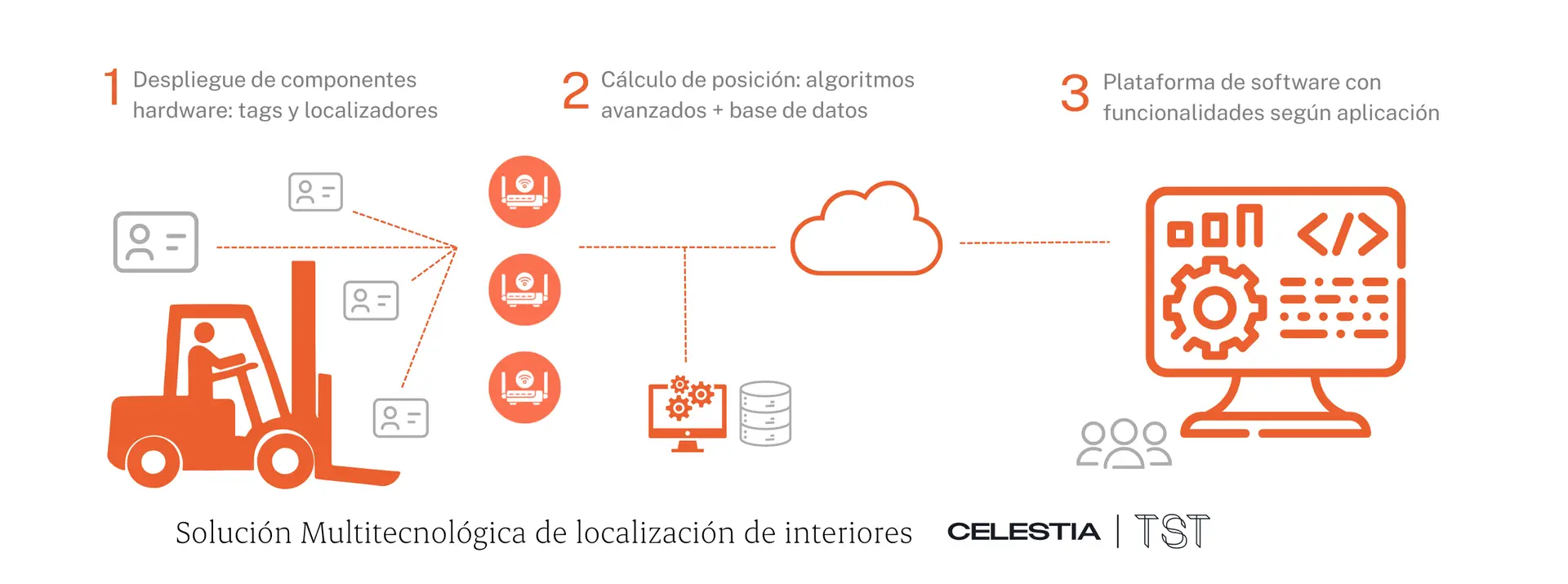
This approach is especially relevant in IIoT, where complex environments (metal, interference, layout changes) coexist with varying accuracy requirements and large‑scale rollout needs—forcing a balance between precision, coverage, latency and total cost.
Edge and platforms: where IoT becomes operations
With more sensors and more analytics, sending everything to the cloud becomes inefficient—and sometimes not viable. In 2026, edge gains weight: decisions closer to the asset, lower latency, and more efficient use of resources such as energy.
At the same time, the platform becomes the deployment’s “brain”: real‑time monitoring, alerts, integrations and automation—so data doesn’t just sit on a dashboard, but creates incidents, triggers responses and connects into the customer’s systems.
In NebulaLink this is supported by an architecture designed to operate at scale: encrypted communication, and a secure REST API with JWT to integrate with ERPs/CRMs and third‑party software.
Fewer “new” platforms, smarter integration
Another quiet shift in 2026: many organisations no longer want to add “yet another platform” for every initiative. They prefer to simplify, reuse what they already have, and connect IoT to their operational and business systems.
In that context, a platform adds value when it acts as a specialised IoT layer (devices, data, rules, alerts) while integrating with the customer’s stack rather than competing with it.
This also explains why the market has moved from very generic horizontal offerings towards more focused, outcomes‑driven solutions. IoT that scales is usually IoT delivered with a clear operational purpose—and integration assumed from day one.

Security: trust as the entry condition
Security is no longer a tick‑box at the end of the project. With IoT entering critical processes, trust becomes a prerequisite: encryption, access control, traceability, and the ability to maintain systems remotely without stopping operations.
This is where practices that were “advanced” a few years ago are now standard, such as remote OTAP updates to reduce travel, cost and risk windows.
From pilot to scale: the use cases setting the trend
Market maturity shows in projects that move from experiment to infrastructure. In 2026, the projects that stick are those designed from the outset for industrialisation: production‑optimised device, logistics, platform and day‑to‑day operations.
At Celestia TST, that end‑to‑end approach becomes a central argument when it links to outcomes: less friction, less risk and faster time‑to‑KPI.
AIoT: from data to a system that acts
The convergence of IoT and AI accelerates the shift from “seeing” to “doing”. In 2026 there is less talk about dashboards and more about automation: detecting anomalies, prioritising interventions, and anticipating scenarios using historical data as decision‑support tools.
Here the same pattern reappears: when the platform enables integration, alerting and evolution (for example, by adding predictive analytics), IoT stops being a technology project and becomes critical business infrastructure.
Conclusion: IoT as critical infrastructure for the digital business
In 2026, IoT stops being an experimental layer and becomes critical infrastructure for competitiveness. It is smarter, more secure, more sustainable and, above all, more results‑oriented.
“The question is no longer how many devices we’re going to deploy, but which decision we want to improve. When IoT is designed end‑to‑end and integrated into day‑to‑day operations, ROI stops being a promise and becomes a KPI.”
”Alberto Puras, Head of Business Development at Celestia TST
Organisations that understand this shift—and act accordingly—won’t just connect devices; they’ll connect decisions, operations and value, in an environment where efficiency and trust make the difference.