
Homedoctor’s Health Robot brings telemedicine into the smart home, combining IoT for healthcare (IoMT) and remote patient monitoring (RPM) to measure vital signs, carry out tests from home and share results with the medical team.
Client Context
Homedoctor began in 2018 as a medical video call project. During the COVID-19 lockdown, the need arose for patients to perform medical tests at home—not only due to restrictions on movement but also to add value by offering remote, real-time primary care.
The Challenge: Time-to-Market in a Critical Scenario
In April 2020, as the pandemic began, the challenge was not only technological but industrial: producing quickly while international markets were closed, maintaining the highest quality standards without relying on traditional suppliers in Asia.
The IoT Solution Developed
The Health Robot enables real-time monitoring of users’ vital signs and detection of anomalies. Among other tests, it can measure oxygen saturation, blood pressure and perform auscultation (lung, cardiac or intestinal). The device automatically notifies Homedoctor’s medical team of completed tests, and a professional diagnosis is issued in real time. Data is collected in Homedoctor BRAIN, a tool that identifies patterns and supports preventive medicine.
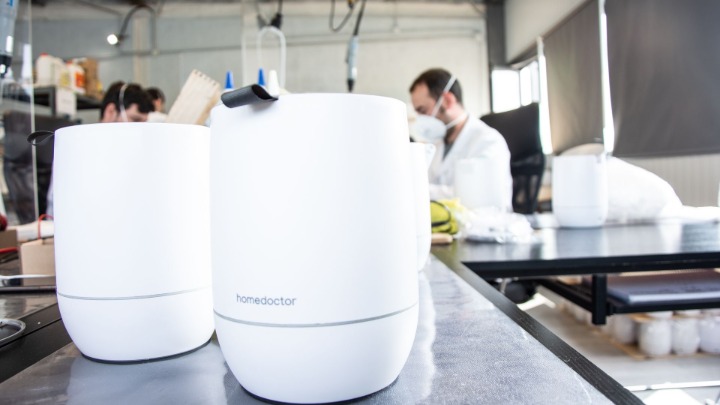
Celestia TST’s Role and Added Value: Large-Scale Industrialisation in 5 Months
To execute the project with deep knowledge of the Spanish industrial ecosystem, Homedoctor partnered with FOM, experts in Industry 4.0, who contacted 15 companies capable of delivering the project within weeks. IDDI Design stood out for leading product design and concept, while Celestia TST took on large-scale industrialisation at its facilities in Santander.
Celestia TST’s differentiator was accelerating time-to-market: in just five months, the project moved from concept to final product, delivering the first 10,000 units to distribution channels and establishing a subscription-based business model.
Results
The project was completed in October 2020, enabling a home telemedicine service supported by connected medical devices, with real-time monitoring and diagnosis, and focused on data-driven preventive healthcare.
It is a connected medical device (IoMT) that measures the patient's vital signs at home and shares the results with the medical team in real time. The Homedoctor robot measures oxygen saturation and blood pressure and performs lung, heart, or intestinal auscultations, among other tests. It automatically alerts the medical team when a test is completed, and the professional issues the diagnosis remotely.
It depends on the complexity, but this project shows that it can be done very quickly when there is control of the process. Celestia TST took the health robot from concept to final product in five months, delivering the first 10,000 units to the distribution channel. That time was possible by manufacturing in Santander, without relying on suppliers in Asia during the pandemic.
Manufacturing medical hardware requires maintaining quality standards in each unit, especially when produced at scale and under tight deadlines. In this case, the industrialisation was done at Celestia TST's facilities in Santander, controlling the process from start to finish instead of outsourcing it, which allowed for maintaining quality while scaling to 10,000 units.
From the very first prototype to thousands of units deployed: discover how we can power your next IoT device.

Written by Ana Escalante Galán, Head of Marketing and Communications at Celestia TST

Technical review: Alberto Puras Trueba, Business Development and Innovation Management.