
In fuel distribution, the price per litre gets you through the door, but what keeps a customer year after year is the confidence that they will never run out. That confidence is built on information: real-time fuel tank monitoring tells you how much is left in each tank before the customer picks up the phone.
Real-time data turns the distributor into someone who anticipates the customer’s needs. And a customer whose problem is solved before it arises has no reason to shop around. This article explains why loyalty in fuel distribution is won through service, and how remote tank monitoring makes it measurable and repeatable.
Why do fuel distributors lose customers?
A distributor loses customers for three reasons that rarely have anything to do with price: a run-out that leaves the customer without fuel, a service that only reacts once there is already an emergency, and a relationship that amounts to delivering litres and nothing more.
When a customer runs out, even once, the damage goes beyond that delivery. The downtime costs them money or comfort, and next time they will ask a competitor for a quote. If every order also depends on the customer calling in time, the distributor is working from estimates and memory. And if all the customer ever receives is an invoice, switching supplier to save a few pence per litre is easy.
Competing on price is a race with no finish line. The room to build loyalty lies where price is not the deciding factor: reliability and anticipation.
What loyalty means in fuel distribution
Building loyalty means making sure the customer never considers switching distributor, because the service solves a problem that price does not touch: the peace of mind of not having to keep an eye on their own tank.
In a transactional relationship, the customer calls, orders and pays. They control supply and the distributor responds. In a partnership, the distributor knows each customer’s consumption, knows when they will need fuel and offers it before a problem arises. The customer hands over a worry, and that has a value that never appears on the invoice.
Three attributes underpin that relationship: reliable supply, with fuel that always arrives on time; proactivity, with a distributor who takes the first step; and accessibility, with a team that responds when needed. None of them depends on price, and all three are strengthened by real-time information.
The role of real-time data
Knowing the level of every tank in real time is what allows you to move from reacting to anticipating. Without that data, the distributor plans around phone calls and estimates. With it, they plan around actual consumption.
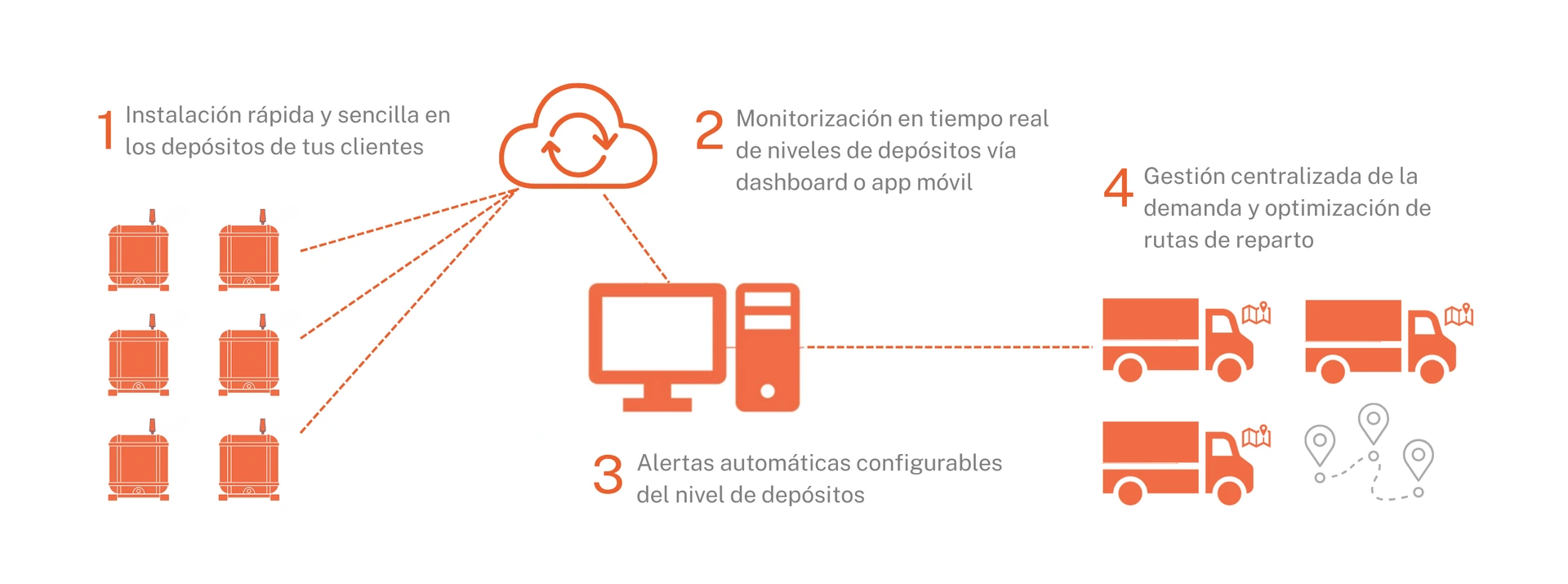
A sensor fitted to the customer’s tank measures the level continuously and sends the reading to a central platform. From there, the system detects each customer’s consumption pattern, calculates when they will reach the reorder point and raises an alert in advance. The distributor no longer has to wonder who will need fuel this week, because the platform already tells them.
That reading gets through from any tank. NivelWatcher uses its own sensors, ultrasonic or radar depending on the type of installation, with Sigfox, LoRa or NB-IoT connectivity depending on coverage at each site. The choice between ultrasonic and radar is covered in detail in another article on the blog; what matters here is that the measurement arrives whatever the shape or location of the tank.
The fundamental shift is that the distributor knows the tank is running low before the customer does, and that information is the foundation of everything that builds loyalty.
Services that turn data into loyalty
Real-time data builds loyalty when it translates into services the customer notices. These are the ones that work best in fuel distribution:
- Guaranteed supply. A commitment that the tank will never drop below a critical level. The distributor keeps watch on the customer’s behalf and schedules the delivery before it becomes urgent.
- Automatic orders. When the level reaches the reorder point, the platform raises the order without the customer having to remember to call.
- Flat-rate pricing. With each customer’s actual consumption in view, you can offer fixed-price plans that give the customer predictability and the distributor recurring revenue.
- Automatic confirmation and consumption-based discounts. Two features that reward an ongoing relationship and make it more convenient.
- Visibility for the end customer. A dedicated profile on the platform where customers can see their level, history and upcoming deliveries. A customer who checks their dashboard every week has one more reason to stay.
Each of these services relies on the same data. NivelWatcher’s fuel tank monitoring enables that entire range of loyalty initiatives from a single investment in measurement.
Data as a barrier to switching
The more proactive the service, the harder it is for the customer to switch distributor. Leaving means giving up a convenience they already take for granted.
A customer who is used to fuel arriving without having to order it, checking their level on their phone and never thinking about the tank sees a change of supplier as a step backwards. They would have to start monitoring, calling and calculating again. The sensor and the platform create a switching cost tied to the service, and that is the hardest kind to match for a competitor who can only move on price.
For the distributor, the result is a more stable and predictable customer base, which is the basis for better route and purchase planning.
The Propenor case: measurable loyalty
Propenor, a fuel distributor within Grupo Cobo, started with a pilot of 5 NivelWatcher sensors. Today it has 50 installed, and it is preparing to deploy another 50 using radar technology.
That jump from 5 to 50 sums up the result. Monitoring allowed Propenor to predict each customer’s needs, plan distribution better and cut its distribution costs by around 10%. The effect on customer relationships was the one this article describes: higher satisfaction and stronger loyalty, because the service started to stay ahead of demand.
A short pilot on real tanks is the way to test that effect without committing upfront.
How to get started
The way to get started with NivelWatcher is a pilot or demo on your own tanks. Within a minute of installation, the sensor starts sending data, and from there you can see on the platform how your customers’ consumption behaves before scaling up. You can see the full solution at NivelWatcher.
Frequently asked questions
Real-time fuel tank monitoring involves installing a sensor that measures the tank level continuously and sends the data to a platform. The distributor knows how much fuel each customer has left without travelling to site or waiting for them to call.
Real-time data lets the distributor anticipate each customer’s needs and make sure they never run out. That reliability, together with services such as automatic orders or flat-rate pricing, retains customers better than competing on price alone.
A fuel distributor loses customers mainly because of run-outs, a service that only reacts to emergencies and competing solely on price. Anticipation and reliable supply build more loyalty than a one-off discount.
The NivelWatcher sensor is fitted on top of the tank with no building work, whatever its shape or location, and starts sending data in under a minute. It uses ultrasonic or radar technology depending on the installation, with Sigfox, LoRa or NB-IoT connectivity depending on coverage.
It lets you offer guaranteed supply, automatic orders when the reorder point is reached, flat-rate pricing, automatic order confirmation, consumption-based discounts and a dedicated dashboard where the end customer can check their level and upcoming deliveries.
The way to start is a NivelWatcher pilot on real tanks: a few sensors are installed, consumption is measured for a few weeks and the results determine how far to scale. Propenor started with 5 sensors and now has 50.