
In many industrial plants, metres of cable are still being laid just to read a temperature, the level of a tank or the status of a remote pump. Each new measurement point involves ducting, construction, permits and, often, halting production. The result is entire areas of the plant without visibility because cabling is not worth it.
LoRaWAN exists to solve exactly that problem. It is one of the most used technologies today in industrial IoT to deploy wireless sensors in the factory, and also one of the most misunderstood: it is asked to do what it cannot provide, or it is not used for what it does better than anyone.
This guide explains what LoRaWAN is, when it makes sense in an industrial plant, what limitations must be accepted and how it fits with the rest of the technologies in the factory.
What is LoRaWAN
It is advisable to separate two terms that are often confused:
LoRa is the radio modulation: the technique that allows signals to be transmitted over long distances (several kilometres), with high penetration in infrastructures, high resistance to electronic noise and very low power.
LoRaWAN is the network protocol built on LoRa: it defines how sensors communicate with gateways, how information is encrypted and how it reaches the platform where the data is exploited.
In the practical sense, a LoRaWAN network has three components: battery-powered field sensors, one or more gateways that collect their messages, and a network server that delivers the data to the visualisation platform or the management system.
Five characteristics define the technology:
- Long range: a single gateway can cover a complete warehouse, an industrial site, or several kilometres in open field.
- Low consumption: the sensors operate on batteries that last for years, without external power or frequent maintenance.
- High resistance to electronic noise, the LoRa spread spectrum modulation is resistant to electronic noise from motors and drives, typical in industry.
- High penetration in infrastructures, UHF (868MHz) radio signals penetrate better in infrastructures.
- Unlicensed bands: operates in the 868 MHz band in Europe, without the need to lease spectrum or rely on an operator.
All of this is optimised for a very specific type of traffic: small data packets, sent infrequently.
When to use LoRaWAN in a factory or power plant
LoRaWAN fits whenever we need to transmit data scattered throughout the plant, for both slowly changing variables and energy submetering, where the resolution by machine, line, and shift is fine even though the point is wireless. The most common use cases:
Monitoring of distributed assets
Fuel storage, water tanks, remote measurement stations, manholes, silos. Points spread throughout the site where running a data cable and another for power would multiply the project's cost.
Slow variables
Temperature,
humidity, level, pressure, equipment status, consumption. Magnitudes where a
reading every few minutes is sufficient and a latency of seconds is not
an issue.
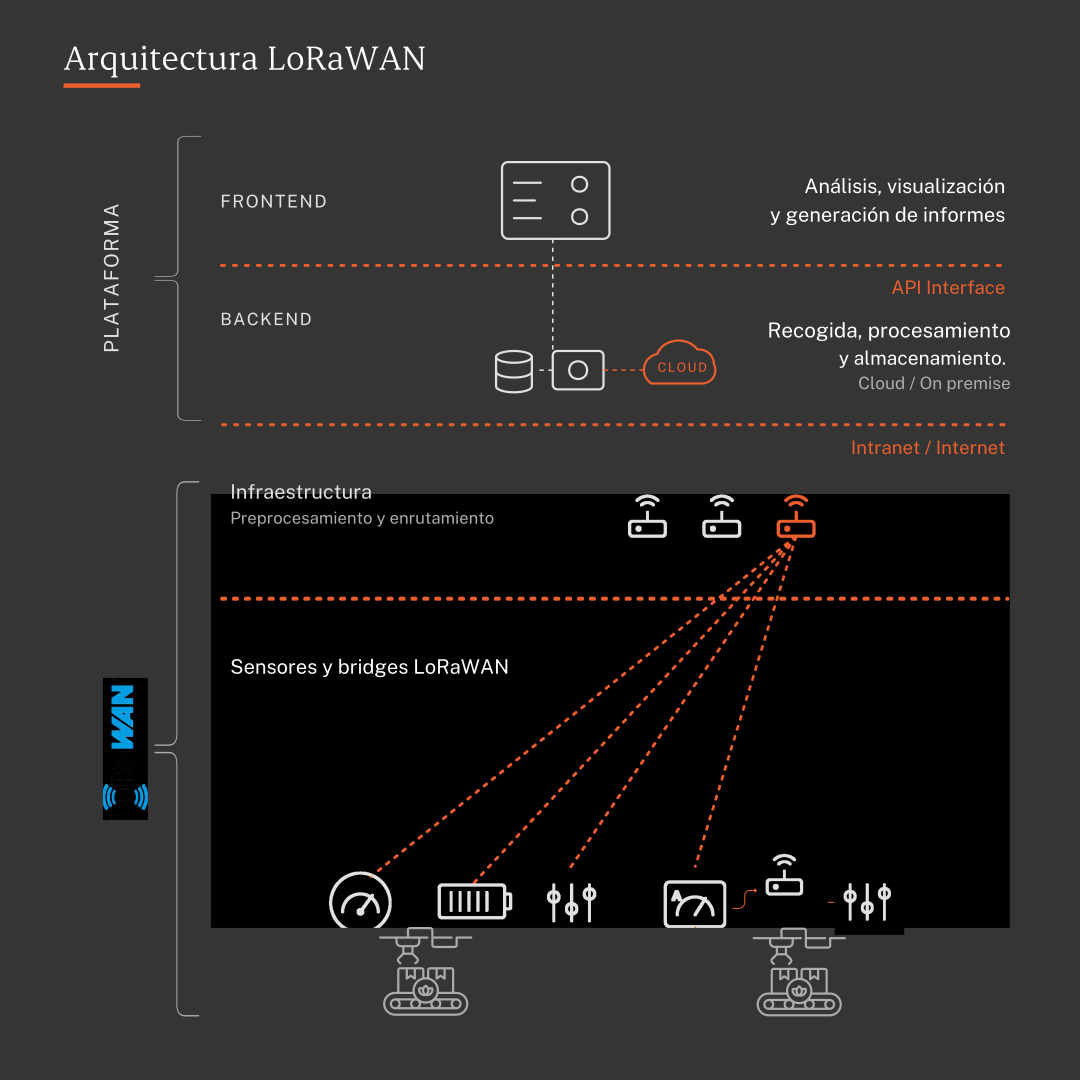
A use case: Energy submetering
One of the most established uses in industry and the core of an energy monitoring solution: measuring electrical consumption machine to machine or line to line without wiring each point. LoRaWAN energy sensors allow deploying dozens of measurement points in days, not weeks, and detecting idle consumption, peaks, and deviations by line or shift. That data, auditable and granular, is also the basis for attributing cost per product or batch and for reporting ISO 50001 and CO₂ footprint.
Difficult to wire areas
Outdoors, pits, galleries, roofs, buildings with complex metal structures or very long layouts. Places where civil works turn a 100 euro sensor into a measurement point costing several thousand.
In all these scenarios, LoRaWAN reduces the investment in wiring and construction, shortens deployment times, minimises initial investment, and allows scaling from ten sensors to hundreds without redesigning the infrastructure.
LoRaWAN limitations: what to accept
LoRaWAN is a specialised tool. Using it outside its domain leads to failed projects. These are its real limitations:
Low data rate
Transmission rates are a few kbps. It is not suitable for video, audio, images, or for collecting large volumes of data in real time.
Regulated duty cycle
In Europe, the regulation for the 868 MHz band limits the transmission time of each device (typically to 1%). This conditions the maximum sending frequency: a sensor cannot transmit every second, and the network design must take this into account from the outset.
Latency of seconds
Messages can take seconds to arrive, there is no guarantee of immediate delivery. LoRaWAN should not be used in closed-loop control systems, emergency stops or any critical safety function. That territory belongs to field buses and deterministic industrial networks.
Communication designed for uploading data, not for downloading it
The architecture is optimised for sensors to send information upwards. Sending commands to the device is possible but limited, which disqualifies frequent actuation applications.
Security that must be designed, not taken for granted
LoRaWAN includes AES-128 encryption as standard, but a network in an OT environment requires more: serious key management, physical and logical protection of gateways, and segmentation from control networks. The technology is secure if the deployment is.
LoRaWAN versus other plant technologies
The correct question in an industrial project is not "Should I use LoRaWAN?" but "What do I need to measure, how often, and what technology fits each need?". In a real plant, LoRaWAN coexists with the rest:
|
Technology |
What it is used for in the plant |
|---|---|
|
Ethernet/IP, Profinet |
Real-time control, automation, security |
|
4G/5G |
Mobility, fast data, communication backhaul |
|
Industrial WiFi |
Equipment with power and high bandwidth in covered areas, tablets, dashboards in the plant |
|
RS485/Modbus |
Direct reading of meters, PLCs and existing equipment |
|
LoRaWAN |
Massive visibility and low cost on distributed assets and consumption |
A well-designed architecture combines several of these technologies, each doing the job it was created for. LoRaWAN does not replace field buses: it covers points that previously had no visibility because cabling them was not worth it.
A typical example
A medium-sized factory with three halls wants to allocate the energy cost by production line. Cabling each measurement point to the panels would have taken weeks of work and partial shutdowns.
The alternative: LoRaWAN submetering sensors on each relevant machine, two gateways covering the three halls, and direct reading via RS485/Modbus of the already accessible meters. The deployment is completed in days, without construction and without stopping production. The data is unified in a centralised platform and connects with the company's ERP or BI software. In projects of this type in multi-line plants, the reduction in the energy bill usually ranges from 15-25% and the investment is recovered in 12-24 months.
(Hypothetical example with indicative figures and timelines, representative of projects of this type.)
How to start
Before buying sensors, it is advisable to make a diagnosis: what is being measured today, what data is already available, where there are visibility gaps that LoRaWAN can cover without construction, and which already accessible sources (PLCs, SCADA, meters) should be read directly to complete the map.
At Celestia TST, that diagnosis is the first step of any energy monitoring project: a map of the plant, the points without visibility, and a proposed architecture in a few weeks. No generic catalogues. The technology is adapted to your operations, not the other way around.
Frequently asked questions about industrial LoRaWAN
It depends on the environment. In open fields, several kilometres. Inside buildings with a metal structure, the range is reduced, but one or two well-placed gateways usually cover entire industrial premises. A prior coverage study avoids surprises.
Between 2 and 10 years depending on the sending frequency and the type of sensor. It is one of the biggest advantages over other wireless technologies.
No, LoRaWAN allows you to deploy your own private network with gateways on the premises, without operator fees or dependence on external coverage. Like deploying a wifi network, but for sensors.
The protocol includes AES-128 encryption as standard. Real security depends on the design of the deployment: key management, gateway protection, and network segmentation relative to control systems.
No. Its latency and architecture rule it out for real-time control and safety functions. Its area is monitoring: measuring, not acting.
Do you want to know if LoRaWAN fits in your plant?
Get in touch with us.