
Spain has doubled its water smart metering in two years. The XVIII DAQUAS Study, presented in December 2025 with data from 2024, places the national inventory at about 22 million meters, of which 38% already have digital remote reading capabilities. In 2022, this figure was 19%.
The leap is real and places Spain among the reference European markets. Berg Insight identifies it as the leading European adopter of NB-IoT for advanced water remote reading, with several large managers in large-scale deployments. Alongside France, it is the historical reference market in this field.
It is worth looking at the breakdown. That 38% groups two distinct things: AMR systems (Automatic Meter Reading) and AMI systems (Advanced Metering Infrastructure). Across Europe, Berg Insight estimates the penetration of AMR plus AMI at 59% of the fleet, but that of AMI at only 23%. Almost two-thirds of what is counted as remote reading does not deliver data with the necessary frequency to operate.
There is an added factor of urgency. The PERTE for the Digitalisation of the Water Cycle mobilised 1.2 billion euros and its execution deadline expired on 30 June 2026. The measurement points that were left out of the deployment no longer have that support: they must be financed from the tariff, and water tariffs in Spain remain below the European average.
Esa combinación explica bastante bien por qué tantos proyectos de telelectura de contadores de agua se quedan a medio camino. No fallan por falta de tecnología. Fallan por decisiones tomadas al principio, cuando todavía parecen detalles.
These are the five errors that appear most frequently in the digitalisation deployments of the water cycle, and what to do instead.
Error 1: assuming a network is digitalised when it only reads remotely
Reading without moving does not equate to operating with data. An AMR system saves reading routes and little more: it delivers a monthly or quarterly data point, without sufficient frequency to detect a leak or to bill without estimation. The network remains opaque between readings.
The value leap is in the frequency. With daily or hourly data, anomalous consumption, early alerts, and billing that does not depend on approximations appear. The Spanish deployments that have reached that point demonstrate it: Canal de Isabel II surpassed one million smart meters in December 2025 out of 1.6 million supply points, and EMASESA reached 73.6% penetration in April 2025 starting from 34% at the end of 2023, according to published data by iAgua.
On a European scale, Berg Insight projects that the AMI park will grow from 34.9 to 74.7 million points by 2031, with an annual growth of 13.5%, according to a published article by Enlit. That is the market movement, and not that of simple remote reading.
How to avoid it: before buying anything, define what data frequency your operation needs to make decisions. Everything else (technology, architecture, budget) derives from that answer.
Error 2: assuming that digitalisation requires changing the meter
The installed meter park is not an obstacle, it is the starting point. With 22 million meters in Spain and about 14 million still without remote reading, the mass replacement approach encounters an arithmetic problem: cost, work, and supply cuts multiplied by millions of points. The usual result is a phased deployment that stretches for years and leaves half the network without visibility while it progresses.
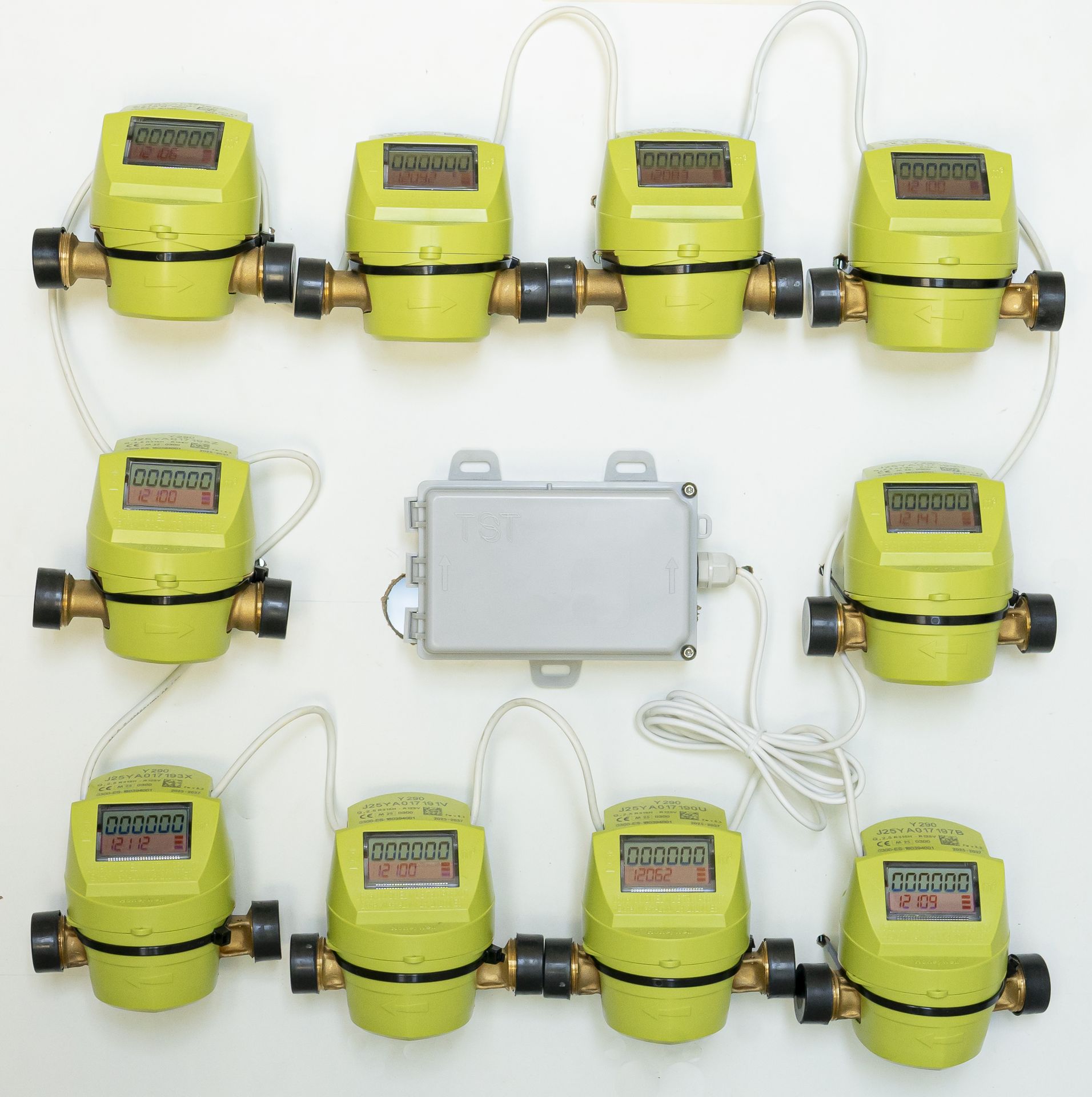
There is a different way. An intermediate IoT gateway connects to the meters that are already installed, either by cable (UNE 82326, RS-485) or by radio (Wireless M-BUS 868 and 169 MHz), and sends the data to the management platform. The meter remains the same. The supply is not interrupted. Remote reading comes into operation in days, not in budgetary exercises.
This is the approach of SmartUtility Water and TSherpa. Celestia TST designs and manufactures gateways, not meters, which allows recommending the technology that fits each section of the network without defending a proprietary catalogue of meters.
How to avoid it: Take an inventory of which protocols your current park uses before budgeting for replacements. In most Spanish networks, a good part of the equipment is already suitable for remote reading with the appropriate gateway.
Error 3: designing the deployment from the easy point
The pilot is done at the accessible connection point and the project breaks at the inspection chamber. It is the most expensive error of the five, because it is not detected until the deployment is underway. A validated device in a street-level cabinet says nothing about its behaviour two metres underground, in a basement with a concrete structure, or in a rural municipality with minimal coverage.
In any mass deployment, there remains a percentage of points in hostile environments. If the solution does not reach there, the manager maintains manual processes in parallel indefinitely, and the promised return is never fully realised. It is precisely the scenario left by the closure of the PERTE: networks with the easy part resolved and the difficult part pending, now without subsidy.
The gateway resolves this by design, as it can be installed where there is coverage, even if the meters are located where there is none. TSherpa gateways exceed a 99% data delivery rate in real field conditions, with 35,000 units deployed solely in water.
How to avoid it: requires the pilot to include the worst points of your network, not a representative sample. If it works in the deep chamber, it will work in the rest.
Error 4: tying yourself to a closed technology
A proprietary protocol turns every future expansion into a negotiation with a single supplier. Nearly 30% of the AMI points installed in Europe use proprietary radio technologies outside the EN 13757 standard, according to Berg Insight. These are networks that work today and that tomorrow can only grow with the same manufacturer, at the price that manufacturer decides.
The cost of that dependency is better seen in the more mature electricity market: between 20% and 50% of the smart meters that will be installed in Europe by 2031 are first-generation replacements, and Spain is one of the markets contributing the most volume to that replacement. Equipment purchased a decade ago that needs to be repurchased.
The counterbalance is open standards and platform freedom. In SmartUtility Water, the data can go to the Celestia TST platform or be integrated directly into the system that the organization already uses, with modular architecture: just a gateway, just a platform, or the complete solution.
How to avoid it: includes an exit clause in the specifications. If migrating to another supplier requires changing field hardware, the design has a problem.
Error 5: deciding on unit cost instead of total cost
The price of the device is the small part of the bill. With the PERTE closed, the investment once again depends on the tariff, so the cost over twelve years weighs more than ever in the decision. Two items eat up the savings of a poorly sized deployment. The first is recurring connectivity, when each meter requires its own SIM and the cost grows linearly with the network. The second is maintenance, when a five-year battery forces a return to the field just when the project was starting to yield.
A shared gateway breaks the rule of one meter, one SIM: a single TSherpa device connects dozens of meters with a single line of connectivity. And with more than 12 years of autonomy, the first maintenance intervention is beyond the project's horizon.
Cómo evitarlo: compara ofertas a diez años, con conectividad, sustituciones de batería y horas de campo incluidas. El orden de los proveedores cambia bastante.
The pattern behind the five mistakes
The five mistakes share a cause: treating remote reading as an equipment purchase when it is an operational project. The useful question is not how many meters remain connected, but what data enters the manager's systems, how often, and with what guarantee that it will continue to arrive in ten years.
And there is still a lot of infrastructure to resolve. With 38% of Spanish meters already on remote reading, the remaining 14 million are precisely the most difficult: small municipalities, deep manholes, community housing, industrial facilities with precision requirements. These are the points where easy deployment no longer works.
Celestia TST has been in IoT for 19 years, with nearly 100,000 devices in the field and design, manufacturing, and support entirely in Spain. This combination allows for adjusting the solution to the existing network rather than asking the network to adjust to a product.
Real, reliable, and timely remote reading. Water management under control.
Main questions answered
AMR sends the meter reading remotely, usually with low frequency and in one direction. AMI provides bidirectional communication and frequent data (daily or hourly), allowing alerts for abnormal consumption, early leak detection, and billing without estimates. In Europe, there is a 59% penetration of AMR plus AMI, but only 23% of AMI.
According to the XVIII DAQUAS Study, with data from 2024, Spain has about 22 million water meters and 38% have digital remote reading, compared to 19% in 2022. Therefore, there are about 14 million measurement points without remote reading.
In most cases, yes. A large part of the stock already emits data via cable (UNE 82326, RS-485) or by radio (Wireless M-Bus 868 and 169 MHz), but no one collects it. An IoT gateway captures it and sends it to the platform, without replacing the meter or interrupting the supply. The rest of the stock is digitised during regular renewal.
A TSherpa gateway manages dozens of meters with a single SIM, which reduces the recurring connectivity cost compared to models that require a line for each measurement point.
This is precisely where the cellular connectivity integrated into the meter fails. With gateway architecture, the IoT device is installed in a location with coverage and collects readings from the meters located in the hostile environment.
Let's talk about your network.
Tell us what your network is like and we will help you identify what type of deployment makes sense in your case.
Written by Ana Escalante Galán, Head of Marketing and Communications at Celestia TST
Technical review: Pablo Pelayo Lastra, Head of the Water & Gas Smart Metering Business Unit.