
The Spain Smart Water Summit 2026, held in Madrid from 29 September to 1 October, has confirmed something that was already suspected in the last congresses of the sector: the digitalisation of water has ceased to be a discussion about whether to connect or not to connect. The relevant question now is what to do with the data once it is available.
In its tenth edition, the slogan "Water is already thinking. Now you decide" summarises this change of stage well. Measurement remains essential, but the real value appears when that information reliably reaches those who manage the network, plan investments, or serve the citizen.
A conversation that has changed
As Pablo Pelayo suggested in this article from Atlas Tecnológico, the sector has moved from talking about connecting meters and complying with regulations to asking a more uncomfortable question: once the data is on the table, what do we do with it? In a context of regulatory, climatic, and economic pressure, that answer has ceased to be a technical detail and has become an operational advantage.
The Summit raised that evolution from the inaugural session. Alejandro Maceira, director of iAgua, recalled that in the first edition, in 2017, the question was which technology to buy; today the issue is who decides, on what criteria, and who is accountable for that decision when something goes wrong. The agenda covered that shift from measurement to decision-making, with artificial intelligence, digital twins, and data quality as guiding threads.
Remote reading explains a large part of that change: according to the data cited at the inauguration, it rose from 19% to 38% of the meter stock in Spain between 2020 and 2024. With that level of deployment, the debate has shifted from installation to the exploitation of information.
From the connected meter to the manageable network
A connected meter resolves the measurement point, but does not resolve, on its own, the network as a whole. This distinction is important: the installed stock before the generalisation of connectivity will remain in service for years and coexists with new equipment, different technologies, and very heterogeneous locations.
Difficult environments also remain. In those cases, the meter generates the information, but there is a lack of a reliable mechanism to collect it and transport it to the platform. As Pablo Pelayo pointed out in the Atlas article, "in any massive deployment of remote reading, there is always a portion of the measurement points in hostile environments (deep manholes, basements, shadow areas) that require maintaining manual processes in parallel".
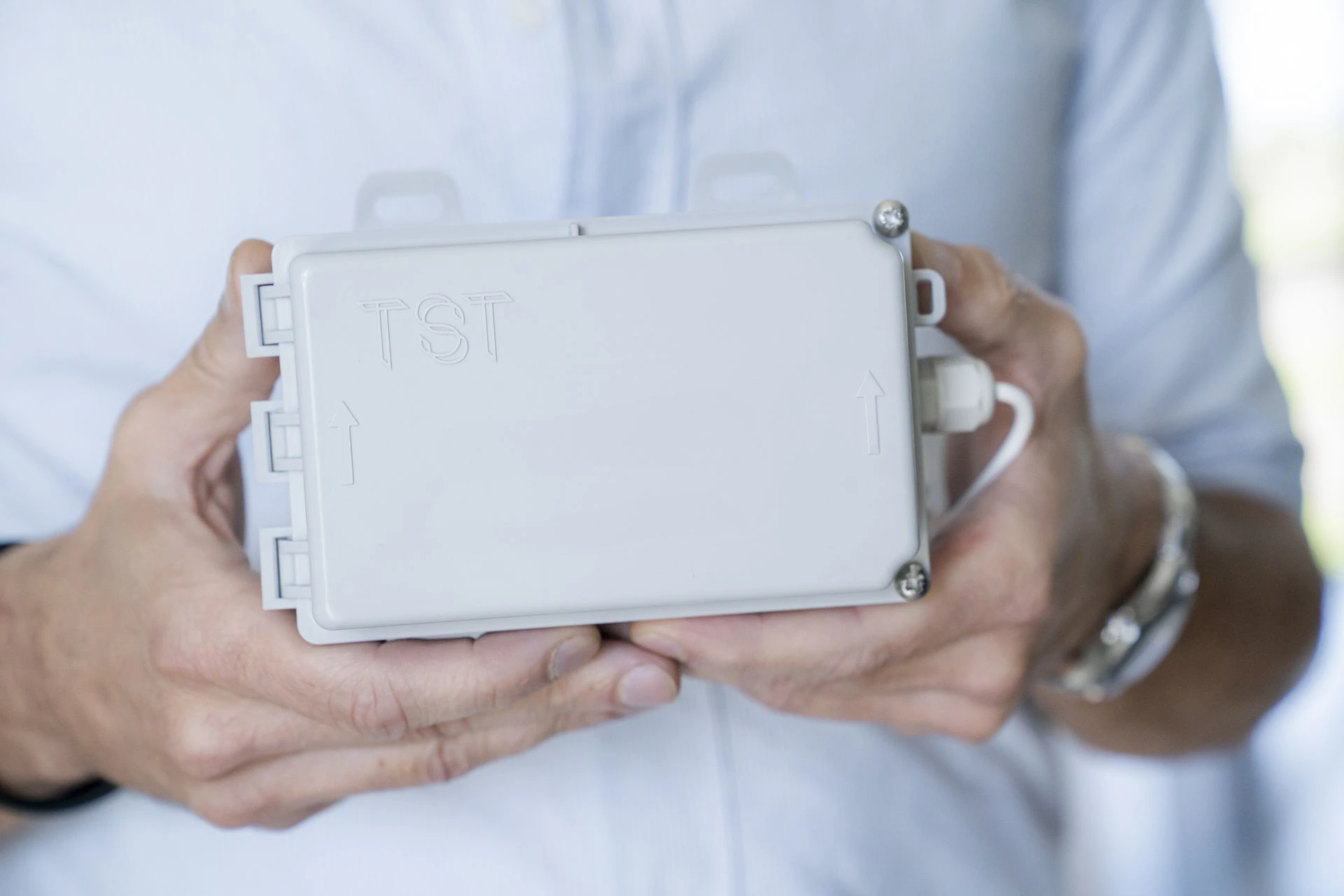
The important thing is that the data arrives complete and on time, regardless of the network that transports it. That is where an intermediate gateway can complement the meter: it collects the reading at the measurement point and transmits it from a location with better coverage. It does not compete with the connectivity integrated into the meter; it addresses a different need.
At Celestia TST we work precisely on that link, with gateways designed to reach where other technologies do not reach and contribute to achieving reading reliability levels of 99.9%.
Not just operators: an ecosystem with many protagonists
When talking about water management, it is common to focus the conversation on the operators. But the digital transformation of the urban water cycle involves many more actors.
- Local councils and administrations, responsible for ensuring the service, planning investments and responding to the public.
- Managing companies and operators, who must maintain the network, control losses, ensure continuity and optimise resources.
- Installers and maintenance companies, who carry out the deployments and need simple, robust solutions that are compatible with the reality of each site.
- Manufacturers of meters and equipment, who incorporate connectivity and evolve their products towards more open standards.
- Technology providers and integrators, who connect the field with management platforms and must avoid adding unnecessary complexity.
- Financial entities, who help turn investment needs into fundable projects.
- Regulators and public administrations, who define the regulatory framework, timelines and investment conditions.
For all of them, the questions are similar, although the starting point is different: do the data arrive when needed?, are they reliable for decision-making?, do they integrate with existing systems?, do they allow for anticipating incidents or prioritising investments?
The answer cannot be solely technological. It depends on a clear data architecture, open standards, simple integrations, and solutions capable of functioning in real conditions for years.
Reliable data to move from reacting to anticipating
Remote reading is often associated with the automation of readings and the improvement of billing. It is an obvious benefit, but it falls short of its potential.
When the data is reliable, continuous, and well-structured, it allows for detecting anomalous consumption, locating leaks before they become significant losses, and planning maintenance in advance. The operation stops being defensive and gains the ability to anticipate.
Artificial intelligence can further expand that margin, but it depends on a prior condition: without reliable and continuous data, there is no valid prediction. The Summit also raised a question that remains open: the ownership of the data and the models trained with years of information from each network, and who assumes responsibility when an algorithm makes a mistake. Well-resolved remote reading is, in that sense, the foundation upon which analytics, automation, and predictive models are built.
Predictability, investment, and collaboration
The Summit also brought to the table predictability, a less visible but decisive need. The digitalisation of water is an investment that pays off over the years and requires clear frameworks, stable financing, and regulatory certainty.
Without that stability, deployments advance at different speeds and the gap between territories translates into differences in efficiency, responsiveness and service quality.
That is why collaboration between administrations, operators, installers, manufacturers, financiers and technology providers is so important. Technology must adapt to real operations, and solutions must provide capacity, not friction.
What the sector needs now
If we had to summarise the lessons from the Spain Smart Water Summit 2026, we would say that the sector needs to move from accumulating technology to building operational intelligence. This involves:
- Measuring reliably, even in complex locations.
- Ensuring data continuity, so that information is useful in day-to-day operations.
- Integrating systems and governing data, avoiding silos and closed solutions.
- Anticipating rather than reacting, with data that allows for the detection of anomalies and planning.
- Collaborating among actors, because the modernisation of the network does not depend on a single organisation.
- Planning with predictability, with stable investment, financing and regulatory frameworks.
Remote reading has already surpassed the stage of promise. The current challenge is to consolidate it as a tool that allows, as Pablo Pelayo suggested, "to govern the network instead of chasing it".
Key questions answered
The digital water meter is now emitting its reading, and the remote reading sends it to the management platform without anyone having to travel to take note. When that signal fails to leave the measurement point, an intermediate gateway collects it and retransmits it from a location with better coverage, so that the data arrives complete and on time.
Yes. These are the points where the meter's signal barely gets out and require maintaining manual readings in parallel. The gateway collects the meter's reading and retransmits it from a position with better coverage, so that chambers, basements, and areas with limited signal are covered and reliability levels of 99.9% are achieved.
No. The gateway works with meters that are already digitised and emit a signal; it does not replace or manipulate the meter. It addresses a different need: to ensure that the reading reaches the platform when the signal cannot get out on its own. The existing fleet remains in service without changes.
Do you have measurement points that aren't reporting due to lack of coverage? See how our remote reading gateways solve this from basement and shadow areas.
Written by Ana Escalante Galán, Head of Marketing and Communications at Celestia TST